Join for FREE | Take the Tour Lost Password?
Shop deviantART for the
holidays and save BIG!
Click here! :holly:
[x]

deviantART

:love:
 
©2009 ~PaleoPastori
:iconpaleopastori:

Artist's Comments

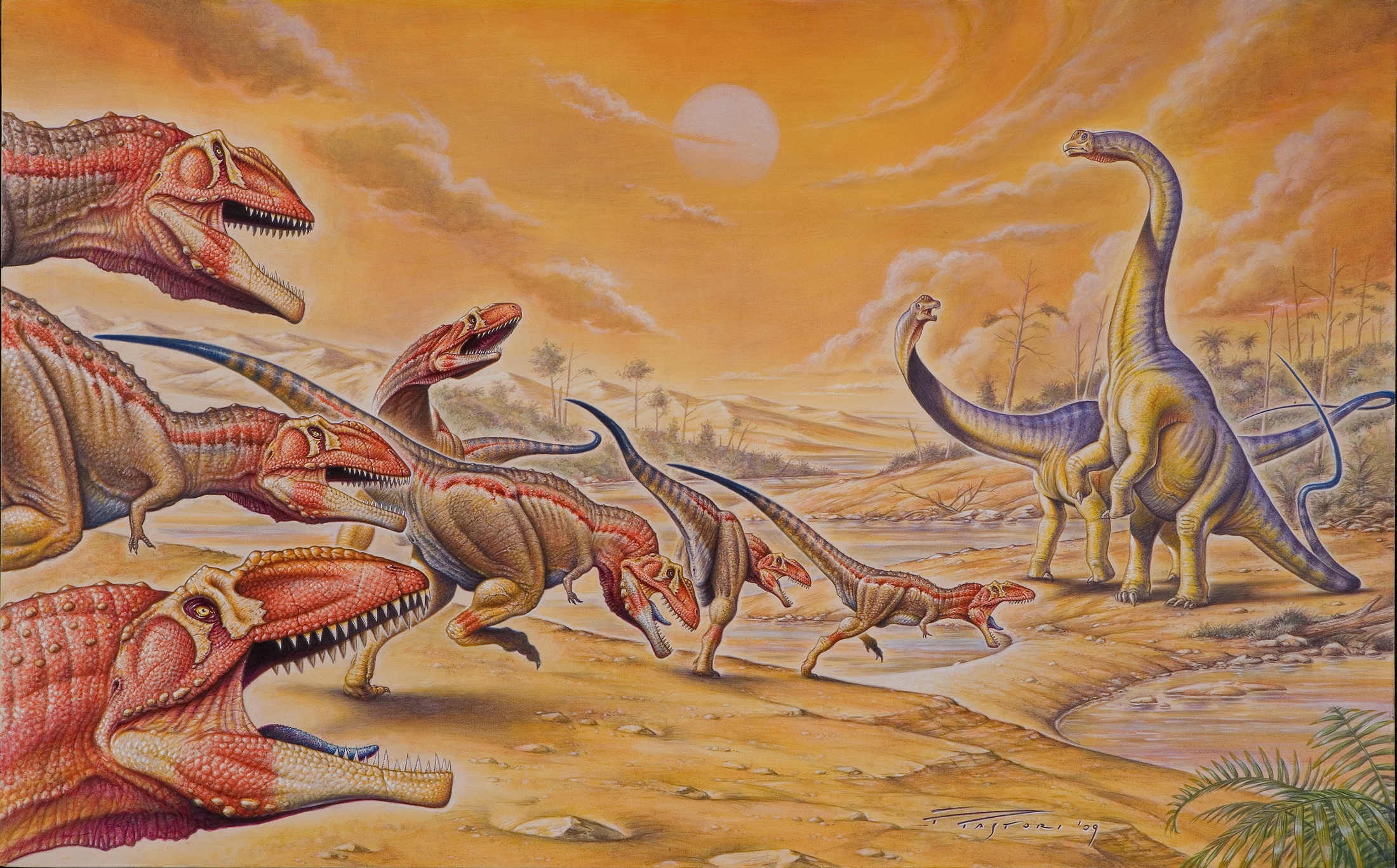
"The Magnificent 7"

Mapusaurus pack vs Argentinosaurus pair

acrylic on canvas 120 x 75 cm - 48 x 30 inches

realized for dr. Michael Sasoni-phisician & paleontologist/Miami

Mapusaurus
Fossil range: Late Cretaceous

Mapusaurus roseae
Scientific classification
Kingdom: Animalia
Phylum: Chordata
Class: Sauropsida
Superorder: Dinosauria
Order: Saurischia
Suborder: Theropoda
Family: Carcharodontosauridae
Subfamily: Giganotosaurinae
Genus: Mapusaurus
Coria & Currie, 2006
Species
M. roseae C
Mapusaurus ('earth lizard';) was a giant carnosaurian dinosaur from the Late Cretaceous of what is now Argentina. It was similar in size to its close relative Giganotosaurus, with the largest known specimens measuring over 12.2 meters (40 ft) in length and weighing over 3 tons.[1] Mapusaurus was excavated between 1997 and 2001, by the Argentinian-Canadian Dinosaur Project, from an exposure of the Huincul Formation (Rio Limay Group, Cenomanian) at Canadon de Gato. It was described and named by paleontologists Rodolfo Coria and Phil Currie in 2006.[1]
The name Mapusaurus is derived from the Mapuche word Mapu, meaning 'of the Land' or 'of the Earth' and the Greek sauros, meaning 'lizard'. The type species, Mapusaurus roseae, is named for both the rose-colored rocks, in which the fossils were found and for Rose Letwin, who sponsored the expeditions which recovered these fossils.
Cladistic analysis carried out by Coria and Currie definitively showed that Mapusaurus is nested within the clade Carcharodontosauridae. The authors noted that the structure of the femur suggests a closer relationship with Giganotosaurus than either taxon shares with Carcharodontosaurus. They created a new monophyletic taxon based on this relationship, the subfamily Giganotosaurinae, defined as all carcharodontosaurids closer to Giganotosaurus and Mapusaurus than to Carcharodontosaurus. They tentatively included the genus Tyrannotitan in this new subfamily, pending publication of more detailed descriptions of the known specimens of that form.
The fossil remains of Mapusaurus were discovered in a bone bed containing at least seven individuals of various growth stages. Coria and Currie speculated that this may represent a long term, possibly coincidental accumulation of carcasses (some sort of predator trap) and may provide clues about Mapusaurus behavior.[1] Other known theropod bone beds include the Allosaurus-dominated Cleveland Lloyd Dinosaur Quarry of Utah, an Albertosaurus bone bed from Alberta and a Daspletosaurus bone bed from Montana.
Paleontologist Rodolfo Coria, of the Museo Carmen Funes, contrary to his published article, repeated in a press-conference earlier suggestions that this congregation of fossil bones may indicate that Mapusaurus hunted in groups and worked together to take down large prey, such as the immense sauropod Argentinosaurus.[2] If so, this would be the first substantive evidence of gregarious behavior by large theropods other than Tyrannosaurus, although whether they might have hunted in organized packs (as wolves do) or simply attacked in a mob, is unknown. The authors interpreted the depositional environment of the Huincul Formation at the Canadon de Gato locality as a freshwater paleochannel deposit, "laid down by an ephemeral or seasonal stream in a region with arid or semi-arid climate".[1] This bone bed is especially interesting, in light of the overall scarcity of fossilized bone within the Huincul Formation.
The designated holotype for the genus and type species, Mapusaurus roseae, is an isolated right nasal (MCF-PVPH-108.1, Museo Carmen Funes, Paleontología de Vertebrados, Plaza Huincul, Neuquén). Twelve paratypes have been designated, based on additional isolated skeletal elements. Taken together, the many individual elements recovered from the Mapusaurus bone bed represent most of the skeleton.
Coria and Currie diagnosed Mapusaurus as follows: "Mapusaurus n. gen. is a carcharodontosaurid theropod whose skull differs from Giganotosaurus in having thick, rugose unfused nasals that are narrower anterior to the nasal/maxilla/lacrimal junction; larger extension of the antorbital fossa onto maxilla; smaller maxillary fenestra; wider bar (interfenestral strut) between antorbital and maxillary fenestrae; lower, flatter lacrimal horn; transversely wider prefrontal in relation to lacrimal width; ventrolaterally curving lateral margin of the palpebral; shallow interdental plates; higher position of Meckelian canal; more posteriorly sloping anteroventral margin of dentary. Mapusaurus roseae is unique in that the upper quadratojugal process of jugal splits into two prongs; small anterior mylohyoid foramen positioned above dentary contact with splenial; second and third metacarpals fused; humerus with broad distal end and little separation between condyles; brevis fossa of ilium extends deeply into excavation dorsal to ischial peduncle. It also differs from Giganotosaurus in having conical, slightly curving cervical epipophyses that taper distally; axial posterior zygapohyses joined on midline; smaller and less elaborate prespinal lamina on midline of cervicals; remarkably sharp dorsal margin of cervical neural spines; tall, wider neural spines; curved ischiatic shaft; more slender fibula."

Argentinosaurus
Fossil range: mid-Cretaceous

Scientific classification
Kingdom: Animalia
Phylum: Chordata
Class: Sauropsida
Superorder: Dinosauria
Order: Saurischia
Suborder: Sauropodomorpha
Infraorder: Sauropoda
(unranked): Titanosauria
Genus: Argentinosaurus
Bonaparte & Coria, 1993
Species
A. huinculensis Bonaparte & Coria, 1993

Argentinosaurus is a genus of sauropod dinosaur first discovered by Guillermo Heredia in Argentina. The generic name means "silver lizard", in reference to the country in which it was discovered ("Argentina" is derived from the Latin argentum). The dinosaur lived on the -then - island continent of South America around 100 million years ago, during the middle of the Cretaceous Period.
Not much of Argentinosaurus has been recovered. The holotype included three anterior dorsal vertebrae, three posterior dorsal vertebrae, first to fifth sacrum vertebrae (only ventral sector the vertebral bodies), most of the sacral ribs of the right side, great part of a fragmented dorsal rib, and the right tibia. One vertebra had a length of 1.59 meters (spine to the ventral border) and the tibia was about 155 centimeters (58 inches).[1] Besides these, an incomplete femur (MLP-DP 46-VIII-21-3) is assigned to Argentinosaurus; this incomplete femur shaft is about 1.18 meters.[2] The proportions of these bones and comparisons with other sauropod relatives allow paleontologists to estimate the size of the animal.
Early reconstructions estimated Argentinosaurus at up to 34.6 metres (114 ft) in length and with a weight of up to 80–100 tonnes (88–110 short tons),[3][4] but were hindered by the lack of relatively complete titanosaurs with which to compare the fragmentary material. The reconstruction of Saltasaurus and Opisthocoelicaudia in 1997, and Rapetosaurus in 2001 help clarify the body proportions of titanosaurs, and new estimates resulted in a considerably smaller Argentinosaurus. The length is estimated as 22–30 metres (72–98 ft).[5][6] Weight estimates are less common, but Mazzetta et al. (2004) provide a range of 60–88 tonnes (66–97 short tons), and consider 73 tonnes (80 short tons) to be the most likely, making it the heaviest sauropod known from good material.
The type species of Argentinosaurus, A. huinculensis, was described and published (by the Argentinian palaeontologists José F. Bonaparte and Rodolfo Coria) in 1993. Its more specific time-frame within the Cretaceous is the Albian to Cenomanian epochs, 112.2 to 93.5 million years ago. The fossil discovery site is in the Río Limay formation in Neuquén Province, Argentina.
Argentinosaurus is featured prominently in the permanent exhibition Giants of the Mesozoic at Fernbank Museum of Natural History in Atlanta, Georgia, USA. This display depicts a hypothetical encounter between Argentinosaurus and the carnivorous theropod dinosaur Giganotosaurus. Contemporary fossils of Cretaceous Period plants and animals are included in the exhibition, including two species of pterosaurs, providing a snapshot of a prehistoric ecosystem in what is now the modern Patagonia region of Argentina. At 123 feet (37 m) long, this skeletal reconstruction represents the largest dinosaur mount ever to be assembled.
[link]
[link]

Comments


love 3 3 joy 1 1 wow 0 0 mad 0 0 sad 0 0 fear 0 0 neutral 0 0
:icontyrannosue:
Wow, ma tu come riesci a colorare così bene? Non credo usi programmi al computer ! (I love this image XD )
:iconpaleopastori:
Tutto esclusivamente a mano....pennello ed acrilici.
per ora sono molto fiero d essere ancora un artigiano dell'immagine...
...vieni al corso d paleoarte che terro' a Roma fine luglio "PaleoArtTeaching"....vedi home page nel mio sito
[link]

--
.Fabio Pastori.
Italian Paleoartist

The Universe does not waste anything:
matter of wich is made of, just transforms.
Klatu
:iconjackneo:
'Mazza... Bellissimo. 0_0

--
Nothing to say, except.. VISIT MY GALLERY! PLEASE!
:icondelirio88:
Vederlo ultimato è una gioia per gli occhi!
Stupendo!
:iconmesozoical:
This is a very magnificent picture. I love the the all around warm feeling I get when I look at the picture. Your coloring choice is also snazzeh, especially in the Mapusaurus.

--
"God creates dinosaurs. God destroys dinosaurs. God creates man. Man destroys God. Man creates dinosaurs...

Dinosaurs eat man, Woman inherits the earth."

- Ian Malcolm and Dr. Sattler, Jurassic Park
:iconraptorarts:
Amazing illustration! Those 2 Argentinosaurs wont have a chance with that many Mapusaurus's going after them.

--
Commissions are always open.
If you like my art feel free to commission me :)
Every commission helps pay for my Rent & Food while in college.
:iconahrkeath:
I love the skin texture on the Mapusaurus! I just want to touch it now! ^^

--
...I've got nothing...
:iconbrokenmachine86:
Magnificent work! A very dynamic and dramatic scene with stunning details. WONDERFUL!

--
"In science it often happens that scientists say, 'You know that's a really good argument; my position is mistaken' [...]. I cannot recall the last time something like that happened in politics or religion."
-Carl Sagan-

Details

May 17
1.3 MB
61.4 KB
600×373

Statistics

23
78 [who?]
2,996 (10 today)
873 (3 today)

Camera Data

Canon
Canon EOS-1Ds Mark II
1/125 second
F/22.0
70 mm
50
May 16, 2009, 9:13:43 PM

Share

Link
Embed
Thumb

Site Map